



FlyNava Insights
Insights and perspectives on airline pricing, revenue management, AI and continuous pricing.
A Day In The Life Of A Pricing Analyst
Discover how continuous pricing is transforming airline pricing strategy. Learn how modern pricing analysts are shifting from manual fare distribution to real-time, data-driven decisions with platforms like Jupiter.

Did You Know Continuous Pricing Is Quietly Reinventing Airline Pricing Strategy?
If you're reading this, there's a good chance you're part of a pricing team that knows this routine all too well:
You log in early.
Fare alerts are already stacking up. Competitor pricing has shifted. Sales has flagged a promotion that needs urgent action. Your screen is filled with fare sheets, booking class updates, and requests to “get it distributed now.”
It’s the rhythm many airline pricing analysts live by—one shaped by a traditional airline pricing strategy that relies on manual workflows, static RBD structures, and reactive decisions.
You work hard. You move fast. But you know deep down that this model can't keep up with today’s market behavior. Something has to change.
I. What Continuous Pricing Looks Like:
Continuous pricing is a modern airline pricing strategy that uses real-time data, machine learning, and automation to dynamically generate and distribute fares. It allows airlines to move beyond fixed price points and update prices in response to shifting demand, competition, and customer behavior—without needing constant manual intervention.
You start your day with a pricing summary tailored to your network.
You instantly see which routes had fare shifts overnight.
You're notified of a potential anomaly on a competitive route.
You spot an opportunity to target a specific market segment—and act on it directly from your screen.
No fare spreadsheets. No last-minute rush jobs. No guesswork.
This is what AI-powered pricing looks like—an intelligent, system-led airline pricing strategy that replaces firefighting with foresight.
II. Let’s Be Honest: Airline Pricing Analysts Deserve Better
Most airline pricing analysts didn’t sign up to chase fares all day. You were hired for your market understanding, your pricing intuition, and your ability to link commercial goals to revenue outcomes.
But in most cases, your day is consumed by updating trackers, validating filings, and ensuring alignment across ATPCO, internal systems, and sales requests.
It’s tiring. It’s inefficient. And it’s no longer sustainable.
Pricing automation through continuous pricing changes that. It eliminates repetitive, low-value work from the fare distribution process and lets you focus on what matters: thinking strategically, testing hypotheses, and improving outcomes.
III. How Continuous Pricing Actually Works
Here’s how modern pricing teams are implementing analyst-led pricing decisions with automation at the core:
Live data ingestion: Pulls from APIs, competitor scrapes, O&D flows, and booking velocity
Machine learning models: Predict price elasticity, demand curves, and customer willingness to pay
Business guardrails: Maintain brand guidelines, ensure margin protection, and apply fare logic
Automated fare distribution: Push updates via API directly into the system, following airline rules
Clear analyst visibility: Dashboards that provide alerts, insights, and real-time performance metrics
The result? Pricing teams remain in control while regaining time and focus.

IV. Real Airlines Are Already Ahead
This isn’t theoretical. Major airlines are already adopting continuous pricing models:
Delta is rolling out AI-powered pricing across its domestic network, aiming to improve yield and personalization.
Lufthansa has implemented continuous pricing on key routes, removing fare jumps and optimizing customer conversion.
Emirates is aligning pricing automation with its broader move toward dynamic retailing and personalized offers.
These are real-world shifts—and they show where the industry is heading.
V. Jupiter: Built for the Airline Pricing Analyst of Tomorrow
Jupiter, FlyNava’s real-time pricing platform, is designed for airline pricing analysts and revenue teams ready to move faster, smarter, and more strategically.
It automates fare monitoring, optimization, and distribution across your network
It integrates with your existing systems—so there’s no need to rip and replace
It manages the fare distribution process in real time, with full traceability and audit controls
It empowers analysts with tools to act, test, and refine—bringing strategy back into pricing
Jupiter doesn’t just support your workflow—it elevates it.
VI. You Don’t Have to Do This Alone
Airline pricing analysts and revenue managers across the world are rethinking how they approach pricing. Not because their previous strategies were wrong, but because the new model offers more control, more insight, and more capacity to grow.
The move toward continuous pricing is no longer a trend—it’s becoming the standard for a high-performing airline pricing strategy.
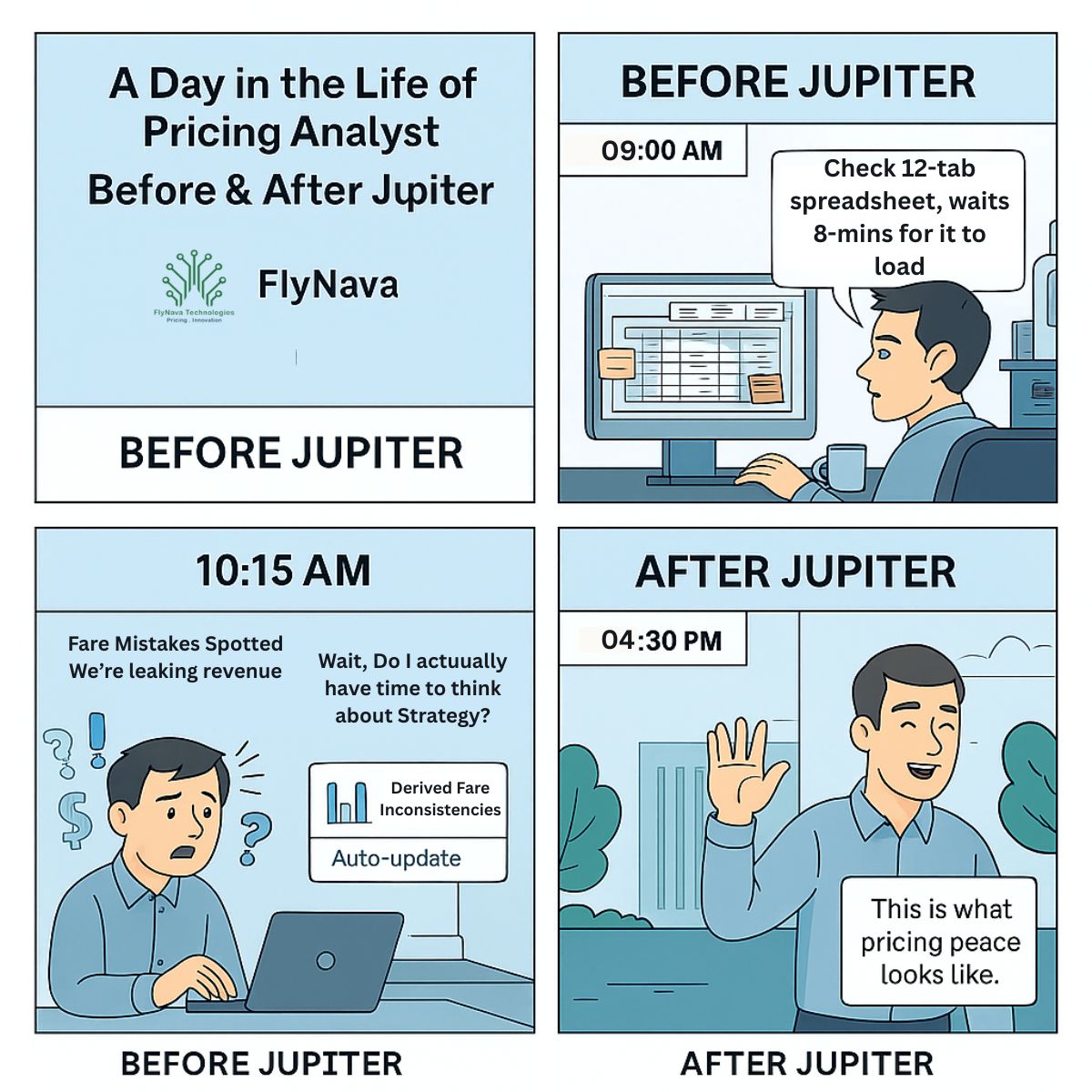
If your team is ready to move beyond routine tasks and toward real strategic influence, Jupiter can help you make that leap.
Let’s connect.
We’ll show you what continuous pricing looks like in action—and how it can reshape your pricing reality.
👉 Schedule a demo with us today.
See Jupiter on your own markets.
Talk to our team about what this means for your network.