



FlyNava Insights
Insights and perspectives on airline pricing, revenue management, AI and continuous pricing.
5 Myths About Dynamic Pricing, and Why It's Every Airline's Smartest Move
Many airlines still hesitate to embrace dynamic pricing. Here’s why those fears are outdated, and how FlyNava’s Jupiter helps teams simplify, automate, and thrive.
Airlines operate in one of the most unpredictable markets in the world. Demand shifts by the hour. Competitors can reshape a route overnight. Weather, seasonality, global events, and booking behavior constantly influence the value of every seat.
In this environment, pricing cannot stay static. It must respond.
Dynamic pricing often looks confusing to travelers — two people booking the same flight minutes apart at different fares. But inside the industry, these variations are deliberate. They reflect real-time demand, market conditions, and revenue opportunities.
Still, many airlines hesitate. Some fear customer backlash. Others worry about complexity or believe their systems cannot support modern pricing. The truth is the opposite. Dynamic pricing is not a risk. It is readiness. It gives airlines the speed and accuracy needed to compete in a volatile market.
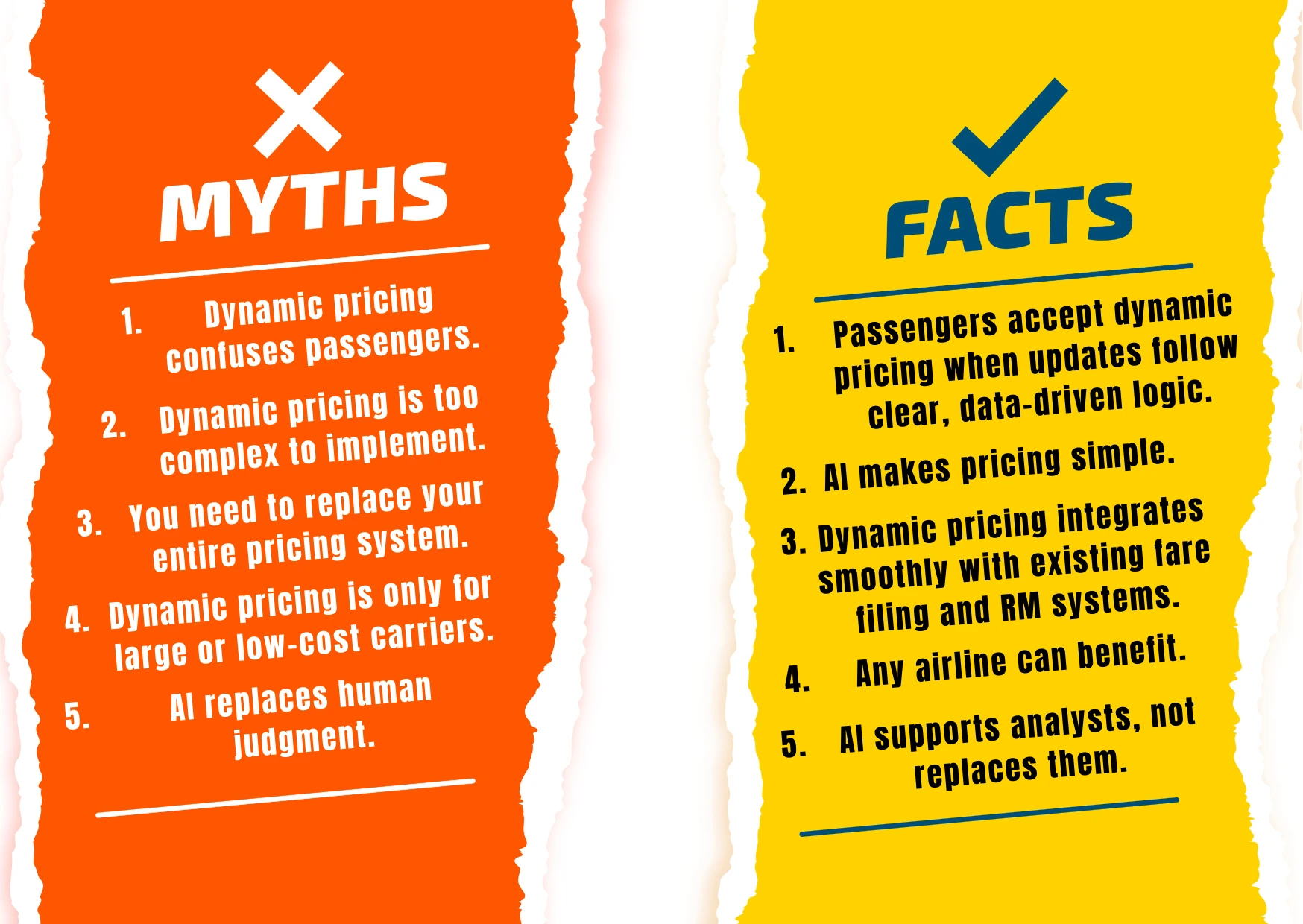
I. Myth 1: Dynamic Pricing Damages Customer Trust
Passengers already experience dynamic pricing across hotels, ride-hailing apps, and events. What harms trust is not price fluctuation but unclear logic.
Platforms like FlyNava’s Jupiter bring transparency to pricing decisions. When fare changes follow real demand and competitive signals, customers perceive them as fair. Dynamic pricing strengthens trust by making pricing more consistent and data-driven.
II. Myth 2: It Is Too Complex to Deploy
This concern comes from an era of rigid systems and manual updates.
Modern AI pricing engines simplify everything. They analyze data, detect demand patterns, monitor competition, and recommend adjustments. Analysts no longer build fare ladders from scratch. They simply review and approve.
Jupiter’s Decision Analyzer handles the heavy analysis so pricing teams can focus on strategy. Complexity doesn’t disappear — it just moves out of the way.
III. Myth 3: It Requires a Complete System Overhaul
Airlines do not need to rebuild their pricing infrastructure.
Most carriers now integrate AI modules into their existing revenue management and fare distribution systems. This approach upgrades intelligence without disrupting operations.
It’s the equivalent of modernizing cockpit instruments rather than replacing the aircraft.
IV. Myth 4: Dynamic Pricing Is Only for Large or Low-Cost Carriers
The opposite is often true. Smaller and regional airlines see fast results because agility works in their favor.
-They react quickly to demand shifts or competitor changes
-Lean teams make decisions faster
-Jupiter gives them access to intelligence used by global majors
-Competitive gaps shrink and pricing accuracy improves
-Dynamic pricing scales to any airline size
Dynamic pricing is not exclusive technology. It’s a competitive equalizer.
V. Myth 5: It Replaces Human Judgment
AI does not remove humans from the process. It empowers them.
Dynamic pricing tools automate repetitive analysis, uncover patterns, and simulate scenarios. Analysts stay in full control of strategy and final decisions.
FlyNava calls this Decision Augmentation — automation handles routine tasks, while analysts guide the direction. The result is faster and more confident pricing outcomes.
VI. The Reality: Dynamic Pricing Builds Smarter Airlines
Dynamic pricing is not about algorithms making choices. It is about using data to support better decisions.
It increases transparency, responsiveness, and alignment with real market conditions. In today’s volatile environment, static pricing cannot keep pace. Airlines using dynamic pricing consistently outperform those relying on manual methods.
With Jupiter, pricing teams act faster, anticipate change instead of reacting to it, and turn fare management into a strategic advantage.
VII. Conclusion
Dynamic pricing is not a risk. Remaining traditional is.
Airlines that adopt intelligent pricing will shape their markets. Those that hesitate will be forced to follow. Jupiter combines AI, automation, and analytics in one platform, making modern pricing accessible and impactful.
Airlines do not need new systems. They need a new approach. Dynamic pricing is already here and with Jupiter, airlines can grow with speed, accuracy, and confidence.
See Jupiter on your own markets.
Talk to our team about what this means for your network.