



FlyNava Insights
Insights and perspectives on airline pricing, revenue management, AI and continuous pricing.
Empower Your Business with Intelligent Continuous Pricing Models
Explore how dynamic pricing and machine learning empower businesses to stay agile, maximize revenue, and deliver smarter offers.

Did you know that businesses using continuous pricing can adapt to market changes almost instantly? In today’s markets, relying on fixed price points leaves organizations exposed to swings in demand, competitor actions, and shifting customer needs. A continuous pricing model—also called a dynamic pricing strategy or real-time pricing engine—uses algorithms and machine learning to adjust prices automatically, ensuring each offer reflects current data without manual steps. By adopting price-optimization software and revenue-management automation, companies can update prices at scale, improve revenue capture, deliver tailored offers, and maintain a competitive position through ongoing pricing analysis.
I. What Is a Continuous Pricing Model?
Unlike traditional tiered structures—where products or services fall into fixed categories—a continuous pricing model treats price as a variable. Systems ingest data such as search trends, sales velocity, and inventory levels, then feed this information into pricing algorithms and automation engines that estimate customer willingness to pay. Business rules enforce minimum margin thresholds, brand guidelines, and promotional limits, enabling repricing that balances profit and customer value.
II. Core Components
The Jupiter platform provides a pricing suite that begins with data ingestion—collecting inputs from web scrapes, APIs, news feeds, and event streams—then applies transformation and feature-engineering pipelines to ready data for machine-learning model training and evaluation. Its MLOps framework fine-tunes and serves predictive models, turning insights into triggers and recommendations. These insights appear in analytics dashboards, while outputs—price forecasts, alerts, and reports—are distributed in formats such as CSV, JSON, or API feeds for downstream systems.
III. Key Benefits
- Market Responsiveness: Enables price and promotion adjustments to support faster pricing cycles.
- Operational Efficiency: Reduces manual work and errors through automation of pricing workflows and consolidated data.
- Scalability: Grows with business needs via ongoing updates, new modules, and a flexible architecture.
- Actionable Insights: Frees users to focus on strategy by automating tasks and providing data-driven recommendations.
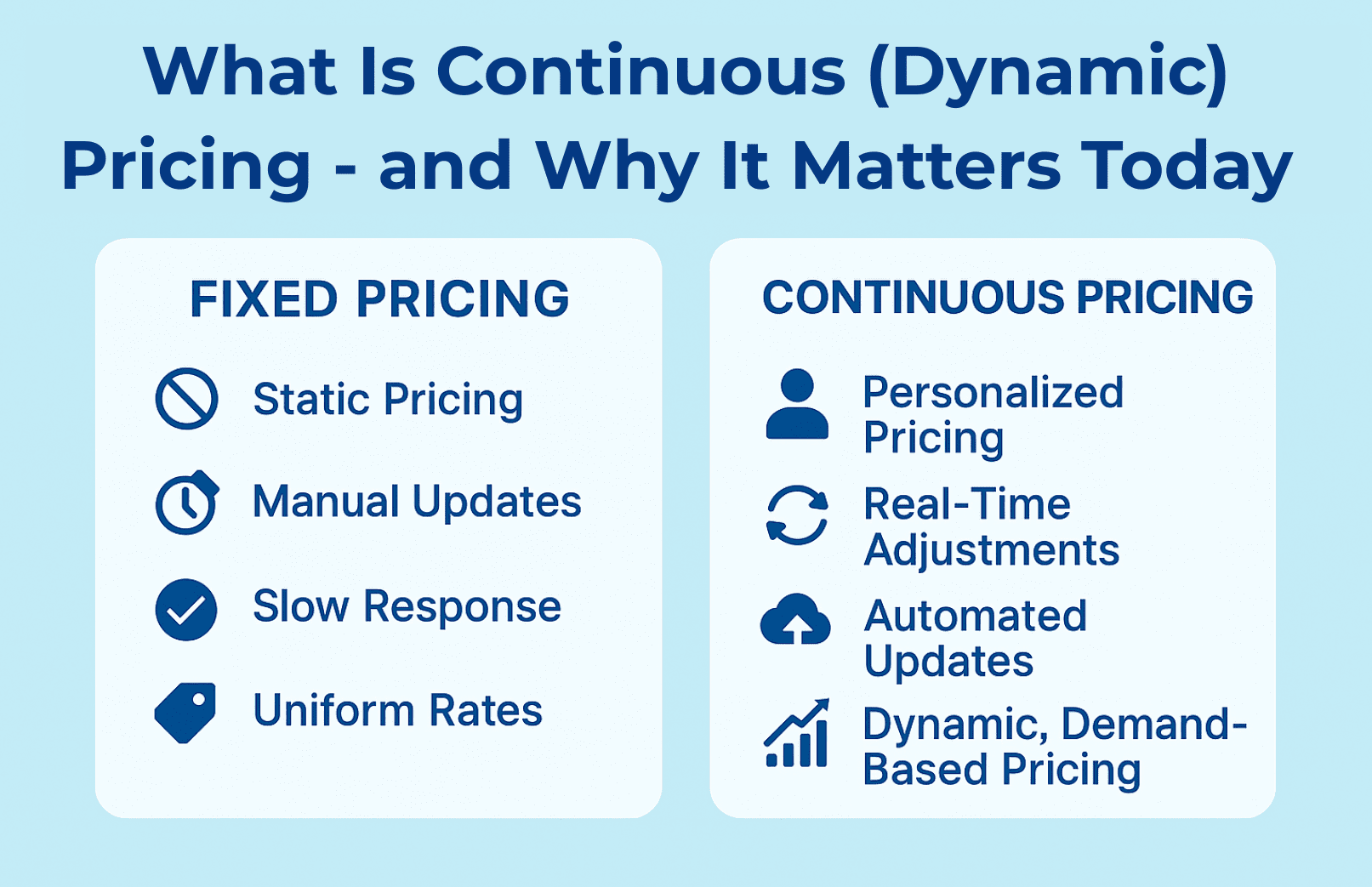
IV. Continuous Pricing: Your Real-Time Market Advantage
Continuous pricing models leverage algorithms and machine learning to dynamically adjust prices, moving beyond fixed rates. This dynamic pricing approach instantly adapts to demand, competitor actions, and customer behavior, ensuring every offer is optimized with current data. It minimizes exposure to market volatility and maximizes revenue.
Implementing this requires price-optimization platforms and revenue-management automation. These tools enable scalable price updates, better revenue capture, and tailored offers. Continuous monitoring and pricing analysis are key to maintaining a competitive edge. Think of airlines adjusting fares by the minute or e-commerce sites reacting to competitor prices – this adaptability is crucial across industries.
V. Implementing Continuous Pricing: Best Practices
To successfully implement continuous pricing, start with clear objectives like boosting revenue or protecting margins. Run a pilot program in a focused area to gather insights. Establish guardrails like price floors and ceilings to maintain fairness and protect your brand. Monitor performance regularly via dashboards and retrain algorithms with new data as markets evolve. Finally, provide comprehensive training for your pricing analysts and revenue managers so they understand the value of these dynamic changes and can effectively address any questions. This ensures a smooth transition and greater customer acceptance.
VI. Conclusion
Adopting a continuous pricing model turns pricing into a strategy that reacts to market changes and customer behavior. With the Jupiter platform, businesses gain a solution that combines price-optimization software, machine-learning pricing, and automation. Jupiter’s dashboards and guardrails help revenue teams apply dynamic pricing and pricing analysis safely and effectively, unlocking new revenue, customer value, and growth.
VII. Next Steps
Contact Us to schedule a Jupiter demo and see how continuous pricing can drive revenue and growth.
See Jupiter on your own markets.
Talk to our team about what this means for your network.