



FlyNava Insights
Insights and perspectives on airline pricing, revenue management, AI and continuous pricing.
Why Airlines Are Embracing Continuous Pricing
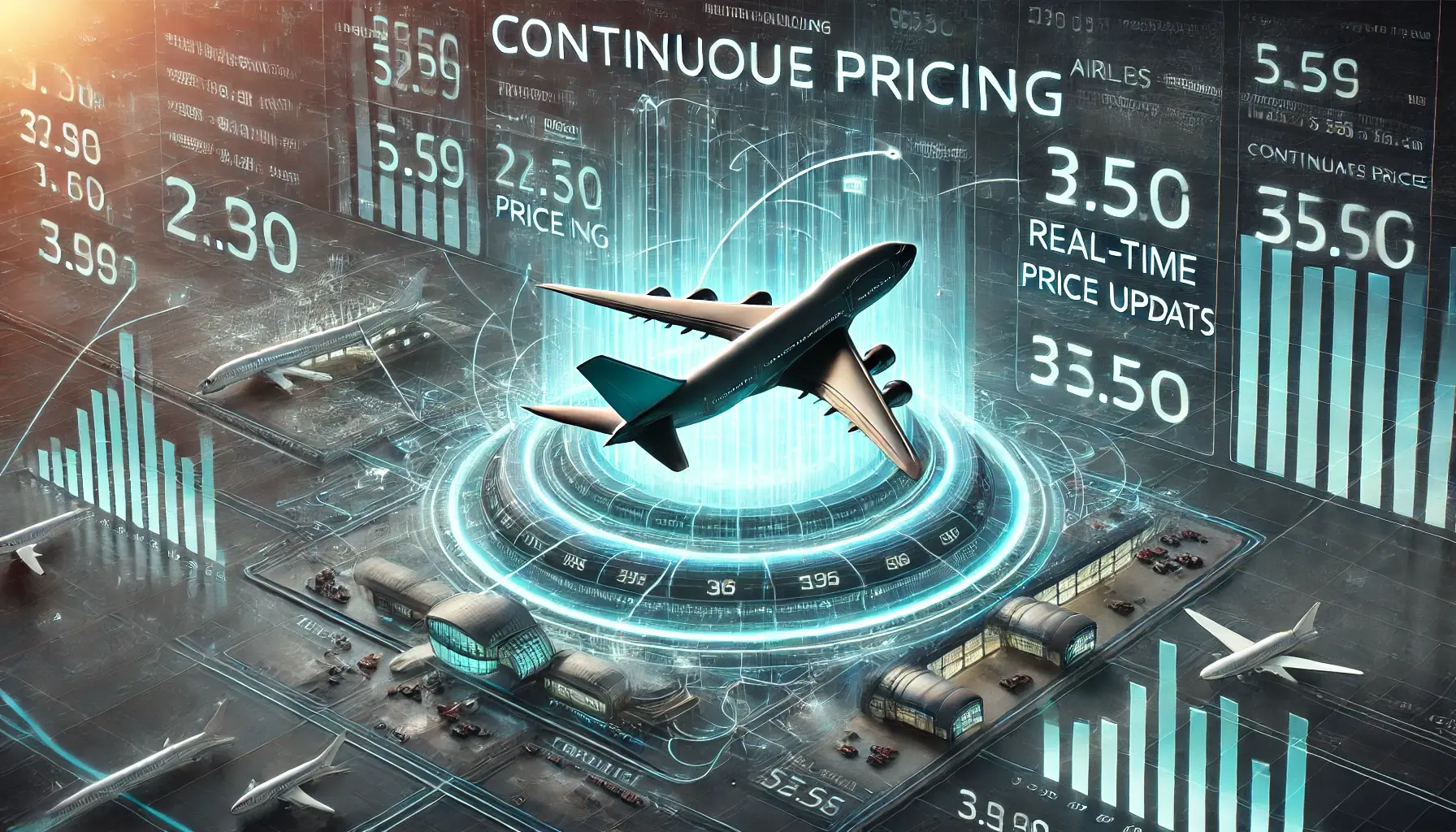
In the ever-evolving business travel sector, the rise of the New Distribution Capability (NDC) standard and the growing influence of continuous pricing are transforming how airlines price their tickets. But what exactly is continuous pricing? How does it differ from traditional and dynamic pricing? And why should you care?
Traditional airline pricing
Historically, airlines have used the EDIFACT data standard to distribute fares in advance through ATPCO, limited to 26 “fare buckets” or booking codes per flight. These buckets, labeled with letters, each have their own rules. Once the lowest-fare bucket sells out, customers must opt for the next higher-priced bucket.
For instance, if fares are distributed at $100, $150, and $200, once the $100 tickets sell out, the lowest available fare becomes $150. In the traditional global distribution system (GDS), airlines can't offer fares between these fixed buckets, like $125. Travel management companies (TMCs) then process these distributed fares to create customer offers based on the fares the airline distributes.
Continuous airline pricing
The NDC standard enables continuous pricing, allowing airlines to offer a range of prices between the traditional fare buckets. While airlines still distribute 26 fares in EDIFACT, they can now make offers at any point between them in their direct and NDC-enabled channels. This means that airlines can offer the $125 fare between the $100 and $150 buckets. Not all airlines with NDC inventory use continuous pricing.
For example, a pioneer in continuous pricing implemented this model for basic economy tickets several years before COVID and now offers it across its entire inventory. The airline’s system makes real-time decisions based on the revenue management system’s assessment of the market-clearing price or bid price for each flight on a given day. This approach requires additional software that integrates with their Revenue Management System.
Dynamic airline pricing
Dynamic pricing and continuous pricing are often confused but have distinct differences. Continuous pricing is the "ability to offer indefinite price points," whereas dynamic pricing adjusts prices "based on contextual information available at the time" of booking, such as length of stay, time before travel, and remaining capacity.
Dynamic pricing isn't new but involves real-time adjustments without needing to distribute fares through a third-party system. NDC channels also allow dynamic pricing to consider personal elements if they know about the traveler or the company they are traveling for. Dynamic pricing can also involve bundling, where the fare might be based on the traveler's history. Traditional EDIFACT pricing also offers price bundles, but these are static and predefined.
Additional insights
The pioneer in continuous pricing reports that about 40% of economy-cabin fares and 25% of premium-cabin fares in their direct and NDC-enabled channels are continuously priced. Continuous pricing often results in lower fares compared to EDIFACT prices. Finding that it provides better price points than traditional models, Oracle began booking continuous-pricing fares with this pioneer. However, fare rules can differ, with lower-priced fares often being more restrictive.
Continuous pricing can impact travel programs, especially those with specific fare contracts. Travel buyers should be open to experimentation and work closely with their TMCs and online booking tools to navigate this evolving landscape. While continuous pricing offers more flexibility and potentially lower fares, it doesn't mean airlines will charge less overall. Airlines may keep legacy fares higher to offer discounts in NDC channels, leading to higher overall costs for companies using non-NDC booking tools.
A sneak peek into pricing innovation
As we look to the future, the airline industry is set for some sky-high advancements. With continuous improvements in decision-making capabilities and pricing innovations like FlyNava’s Jupiter, the possibilities are endless. This game-changing product is ready to revolutionize the airline industry, enabling real-time decisions and automated processes.
Packed with features like auto-pilot pricing triggers, performance management, an interactive analyst dashboard, and AI/ML-powered market intelligence, it's set to redefine pricing and revenue management, boosting ROI by 2-4%. The integrated big data platform eliminates the need for manual data gathering, allowing users to seamlessly test their data with a free proof of concept (POC), making it a true breakthrough for the airline industry.
Continuous pricing offers greater flexibility and potentially lower fares for travelers, though it requires travel managers and TMCs to adapt. Tools like FlyNava’s Jupiter further enhance this shift, promising significant ROI improvements and a more sophisticated pricing strategy. Embracing these changes is essential for staying competitive and improving the travel experience.
See Jupiter on your own markets.
Talk to our team about what this means for your network.